A Stronger Mold: PTA Plastics & PCS Company Build Success Through Partnership
When it comes to mold building, PTA Plastics takes DIY to the next level—part of its mission to be a disruptor in its market segment.
Founded in 1953 in Bridgeport, Connecticut, the now fully employee-owned company builds 90% of its tooling in-house. PTA produces between 100 and 125 tools per year, with 85% supporting the medical industry.
Most of PTA’s mold building takes place at its Longmont, Colorado facility, with additional support from its team in Oxford, Connecticut. All molds—ranging in size from 12 to 48 inches square—are customized with core cavity inserts that must drop into bases made to exacting standards.
PTA’s low-volume, high-mix production for top medical OEMs results in approximately 250 mold changeovers per month at each facility. PTA also maintains ISO 13485:2016 (medical device QMS), ISO 9001:2015, and MedAccred accreditation.
That adds up to a high bar to meet, says PTA Plastics President Rich Dorans—but PTA has a secret weapon.
To meet the rigorous demands of medical part production, PTA partners with mold base supplier PCS Company—the only U.S.-based company that not only manufactures mold bases, but also supplies mold components and molding products. Their partnership, spanning over five years, is a testament to creating a tightly controlled supply chain built on mutual knowledge sharing and best practices.
The collaboration between PCS and PTA “is unusual today and an advantage over our competition,” Dorans says. “We specialize in mid-volume injection molding, value-added assembly, full engineering support, and in-house tooling. Our upfront engineering and DFM support help us reduce lead times and eliminate many post-Tier 1 issues common to other programs.”
A Versatile Fleet of Machines
PTA specializes in durable products for leading medical OEMs—items like automated external defibrillators and patient monitors.
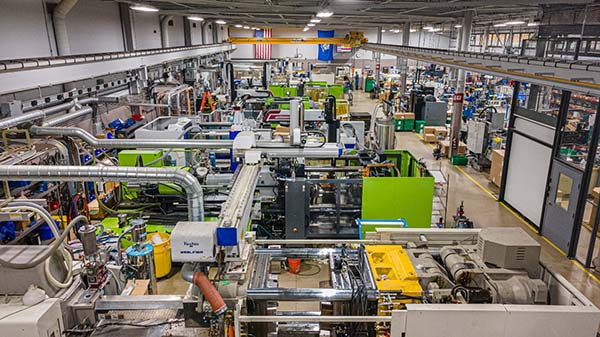
To produce them, PTA utilizes 41 total injection molding machines. In Colorado, the company operates 20 IMMs ranging from 30 to 1,235 tons, while the Connecticut site runs 20 IMMs from 45 to 720 tons.
These machines are loaded with molds built in-house by PTA and mounted on bases provided by PCS. PCS handles finishing on pockets, ejector holes, water components, and hot-tip geometry.
“We're doing all of the fitting, so it's a big time saver,” Dorans explains. PTA’s 12 toolmakers check the bases for squareness, drop in the core cavity inserts, and complete the fitting. Most molds are produced in eight to 12 weeks. Some incorporate 3D-printed conformal cooling channels provided by third-party vendors. PTA is also adding a Zeiss CT scanner to enhance its validation process.
Among PTA’s CNC machines are Makino, Mori Seiki, 5-axis DMG, and a 5-axis Röders electrode machine. Industry 4.0 capabilities are being integrated across PTA’s molding cells. Three mold designers—part of a 250-person staff across both facilities—use Cimatron CAD/CAM software.
Productive Partners
PTA first connected with PCS around 2019, when “our team was looking to reduce risk by consolidating to a single supplier,” Dorans recalls. “PCS’ quality and values were a match.” PCS demonstrated a strong commitment to accuracy, communication, lead time transparency, and accommodating custom requests.
“When PTA reached out, we were confident we could deliver what they needed,” said PCS Company President Angela Elsey. “Our unique position as a one-stop-shop partner allows us to overcome long lead times, especially for nonstandard sizes.”
Midrange sizes are most commonly used by PTA, with average molds around 18 inches.
Previously using other suppliers, PTA now benefits from PCS’ in-house machining, which keeps lead times attractive and allows PTA to focus on core, cavity, and assembly work.
“If we have multiple bases on order, PCS works with us to prioritize,” Dorans says. “We’re not expecting everything immediately—but if one is urgent, PCS will shift schedules to accommodate. It’s been a really great relationship.”
The bond is also strengthened by Elsey and Dorans’ shared participation in the Wipfli (HRI) Manufacturing Senior Roundtable, where they exchange insights on operations, culture, and planning beyond day-to-day business.
Looking Ahead
Around the same time the PCS partnership began, PTA launched its PTA 2030 team, now rebranded as PTA 2035. This cross-functional, diverse group looks ahead to align with future technologies and trends.
“We want to be a disruptor,” Dorans notes. “AI will be a game changer—not just in tooling, but in molding too.”
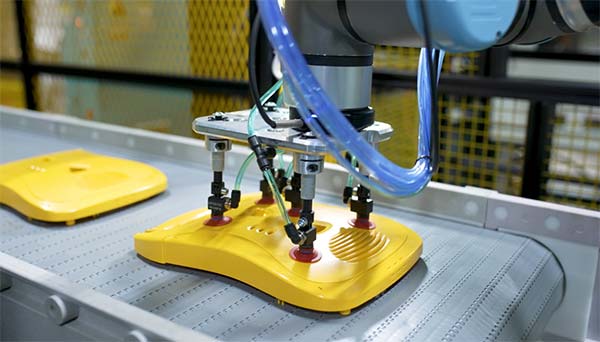
PTA is already integrating advanced automation, with cobots supporting press automation, quality checks, packaging, and palletizing. The company is also exploring intelligent manufacturing through predictive maintenance, real-time process adjustments, and smart factory flexibility.
As technology evolves, sharing best practices with strategic partners like PCS gives PTA a distinct edge.
“Partnerships are great, but consultative relationships are even better,” Dorans says. “That’s the level we strive for—sharing roadmaps and technology. That’s what we have with PCS, and it’s rare to find.”